


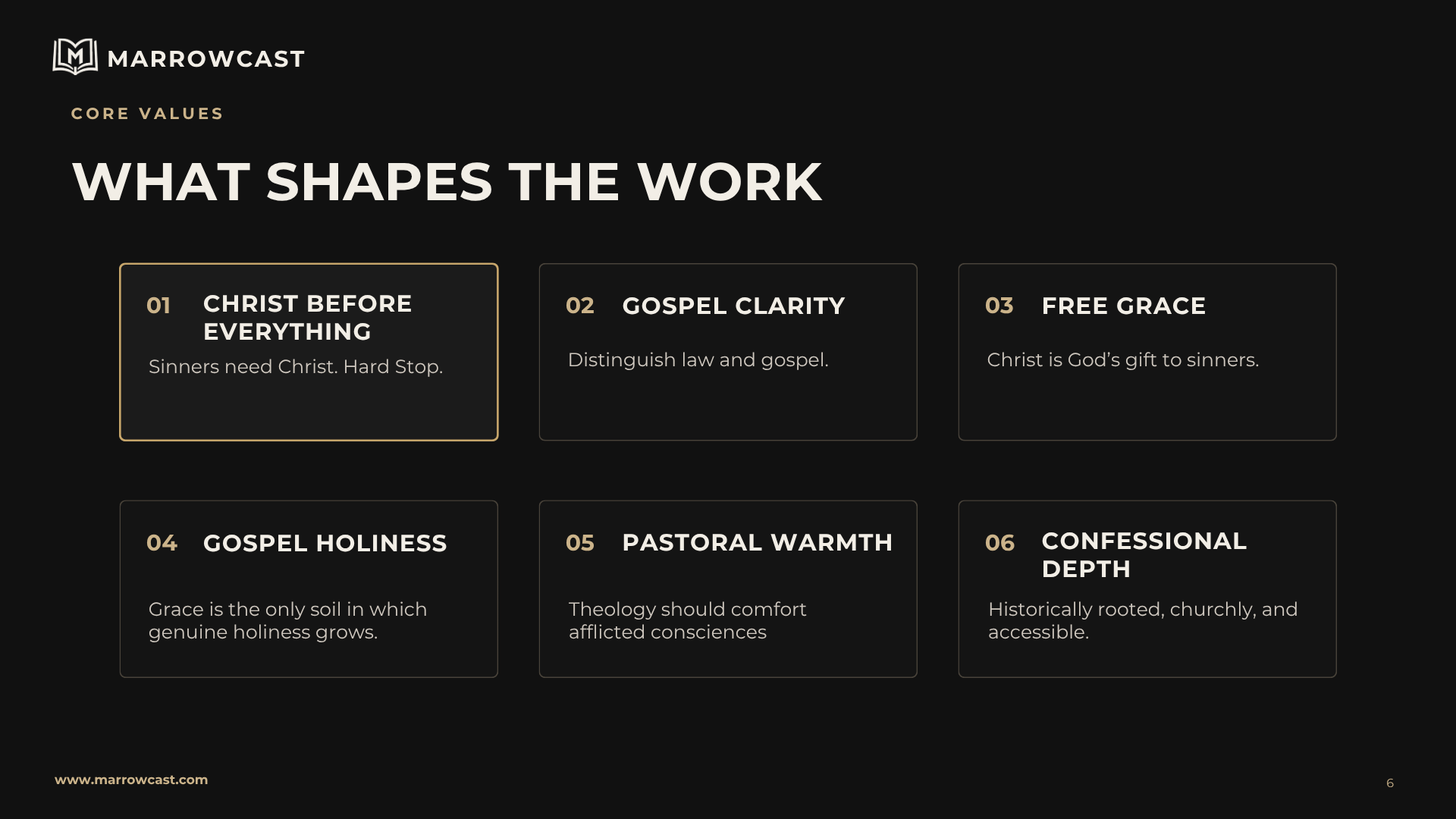
Marrowcast is being built around a handful of theological and pastoral commitments that we want to shape everything we do.
That includes the podcast, the articles, the teaching posts, the newsletter, the short clips, the future resources, and anything else that may develop over time.
That means the shape of Marrowcast matters.
The first commitment is simple: Christ before everything.
Marrowcast exists because sinners need Christ, saints need Christ, pastors need Christ, and churches need Christ held before them with clarity and confidence.
The center of this work is not a controversy, a brand, a personality, or even a theological system considered by itself. The center is the living Christ, freely offered in the gospel and fully sufficient for every need of his people.
We want everything we produce to serve that end.
If we talk about law and gospel, it is because we want Christ to be seen clearly. If we talk about assurance, it is because we want troubled consciences to rest in Christ. If we talk about repentance, obedience, or holiness, it is because the same Christ who justifies his people also sanctifies them by his Spirit.
The second commitment is gospel clarity.
A great deal of confusion in the Christian life comes from blending what God commands with what God gives. The law exposes sin, commands obedience, and shows us our need. The gospel gives Christ, announces what he has done, and receives sinners freely through faith. When these are confused, consciences are burdened, Christ is obscured, and obedience is either turned into the ground of peace or treated as optional.
We want Marrowcast to help pastors, churches, and ordinary Christians distinguish law and gospel without dividing Scripture, weakening obedience, or confusing the fruit of grace with the foundation of our acceptance before God.
The third commitment is free grace.
Marrowcast is committed to holding forth Christ as God’s gift to sinners, not as a reward for the sufficiently prepared. The warrant for coming to Christ is not found in the quality of our repentance, the depth of our sorrow, the strength of our faith, or the evidence of our spiritual progress. The warrant for coming to Christ is found in the gospel promise itself.
That does not minimize repentance, holiness, or obedience; it puts them in their proper place. We come to Christ because he is freely offered to sinners, and the grace that receives us is also the grace that begins to renew us.
The fourth commitment is gospel holiness.
We believe grace is the only soil in which true holiness grows. Legalism cannot produce the holiness God requires, because legalism turns obedience into the ground of peace and drives the soul back into bondage. Antinomianism cannot produce holiness either, because it detaches obedience from the grace that saves and transforms.
The Marrow tradition helps us reject both errors. The answer to legalism is not lawlessness, and the answer to antinomianism is not bondage. The answer is Christ himself, received by faith, proclaimed freely, and trusted as the one who justifies and sanctifies his people.
The fifth commitment is pastoral warmth.
We are not retrieving Marrow theology so we can win arguments, build a niche audience, or sound historically informed. We are retrieving it because afflicted consciences need comfort, weary Christians need Christ held before them, and pastors need help preaching the gospel freely and clearly.
That means the tone matters. Marrowcast should be serious without being cold, it should be doctrinal without becoming merely academic, and it should speak to real people in real churches, not just to the small circle of people who already know the terms and debates.
The sixth commitment is confessional depth.
Marrowcast is rooted in historic Reformed and confessional theology. We want to make that inheritance accessible without making it shallow. The goal is not to flatten the tradition into slogans, but to retrieve it carefully, explain it clearly, and apply it plainly.
We want the Marrow tradition to be a living resource for preaching, counseling, discipleship, assurance, sanctification, and ordinary church life.
I love this. These are essentially what we desire for our church plant here in Avon.
Let’s go!